
Live Betting at Ascot: In-Running Strategy for Royal Ascot
 Available in US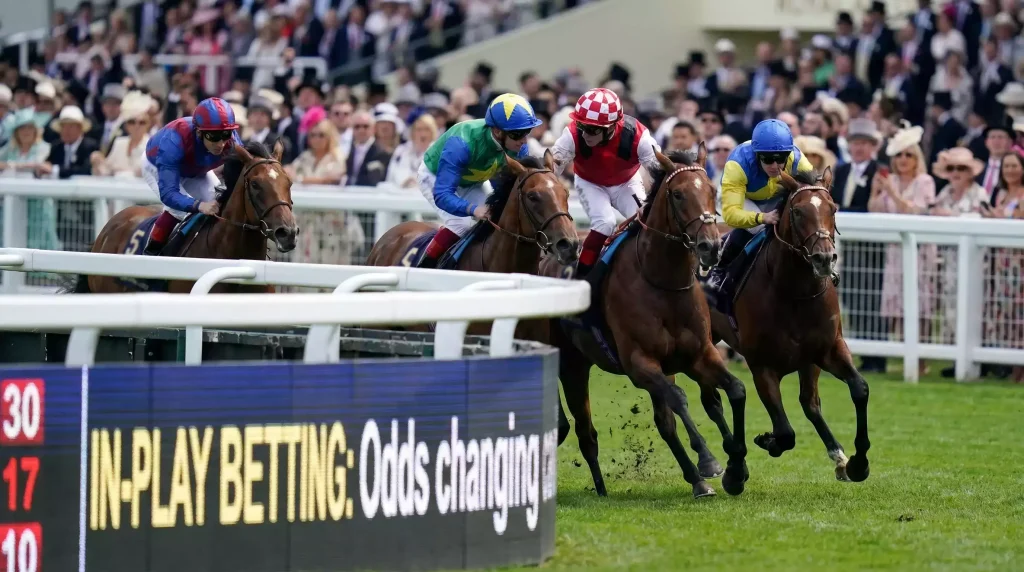
Betting After the Gates Open
Live betting Ascot opens possibilities unavailable to pre-race punters. Once the stalls open, prices move in real time based on positioning, pace, and the evolving shape of the race. Those who can read these dynamics—and react faster than the market—find value that doesn’t exist before the off. Royal Ascot’s high-profile races generate exceptional in-running liquidity, making live betting viable at scale.
The meeting’s international significance drives that liquidity. World Pool turnover at Royal Ascot 2025 reached approximately £150 million, with substantial additional activity on betting exchanges. This depth means prices move efficiently but also creates moments where information hasn’t fully processed into odds—gaps that in-running bettors exploit.
Live betting requires different skills than pre-race analysis. You’re no longer assessing form in the abstract. You’re watching a race unfold and making rapid judgments about whether positions and pace favour certain horses. A closer stuck wide on the first bend is worse off than their pre-race price suggested. A front-runner given an easy lead is better off. These assessments happen in seconds.
Not every race suits in-running betting. Sprints finish too quickly—by the time you’ve assessed the pace, the race is effectively over. Middle-distance and staying races offer more opportunity; there’s time to evaluate, place bets, and see positions develop. The Ascot Stakes over two-and-a-half miles provides minutes of in-running trading opportunity. The King’s Stand Stakes over five furlongs provides almost none.
What follows is a framework for approaching live betting at Royal Ascot. The aim isn’t to bet every race in-running but to identify situations where in-play positions offer genuine value over pre-race prices.
Price Spikes: When Favourites Drift
Favourites at Royal Ascot win approximately 32.95% of races—which means 67% of the time, the market leader loses. In-running betting allows you to back favourites at inflated prices when early race dynamics appear unfavourable, then watch them recover to win at odds significantly better than SP.
Price spikes happen when favourites find trouble. A slow start sends prices drifting as the market assumes the horse has too much ground to recover. Being caught wide on the first bend triggers similar reactions. Getting boxed in behind slower horses creates concern that the favourite can’t access racing room. Each situation causes the favourite’s price to spike—sometimes dramatically.
The question is whether the trouble is terminal or recoverable. A favourite who’s missed the break by three lengths in a five-furlong sprint has almost certainly lost. A favourite who’s missed the break by three lengths in a two-mile handicap has plenty of time to recover—if the ability exists. Learning to distinguish recoverable trouble from race-ending trouble is the core skill of in-running trading.
Watch jockey reactions. A jockey who switches off, accepting the situation, signals resignation. One who continues pushing for position, working to improve, believes recovery is possible. Jockeys know their mounts. Their behaviour reveals expectations that prices haven’t yet absorbed.
Big-field handicaps produce more price spikes than small-field Group races. With 25 runners, positional problems happen frequently. The favourite might be shuffled back at the start, forced wide around a bend, or caught behind a wall of slower horses. Each incident creates a spike. Not every spike represents value—sometimes the trouble genuinely compromises chances—but regular opportunities exist for assessment.
The profit comes from backing favourites at 4.0 in-running when their pre-race price was 2.5 and their actual chance of winning remains around 35%. The market overreacts to visible trouble; you buy the overreaction and profit when the favourite recovers to win.
Pace Collapse Scenarios
Pace collapses transform race dynamics. When the early leaders go too fast—burning themselves out before the home straight—closers who appeared hopelessly positioned suddenly hold winning chances. Recognising developing pace collapses allows you to back runners at huge prices before the market catches up.
The visual signs are distinctive. Leaders who were travelling strongly begin to struggle. Their jockeys shift from sitting still to pushing actively. The gap to pursuing horses shrinks rather than holds steady. Horses who were cruising in mid-pack start closing without obvious effort from their jockeys. These signals indicate that the pace has been unsustainably fast.
Staying races on soft ground produce frequent pace collapses. The Gold Cup and Ascot Stakes, run over extreme distances on ground that can tire horses quickly, regularly see leaders stop in the final furlongs. If you’ve identified a closer with proven stamina in these races, watching for pace collapse signs creates in-running opportunities.
The risk is timing. You want to back your closer before the market fully recognises the collapse—but not so early that the leaders might still hold on. This judgment improves with experience. Initially, you’ll sometimes back too early (before collapse confirmation) or too late (after prices have already shortened). Neither error is fatal if stakes are controlled.
Pace collapses matter less in sprints. The races finish too quickly for late-developing advantage to materialise. A five-furlong race might see the leader tire in the final half-furlong, but closers need more than fifty yards to mount a challenge. The opportunity window is minimal. Save pace-collapse analysis for races of a mile or further.
When to Strike In-Running
Optimal entry points vary by race type and situation. In big-field handicaps, the early stages often create chaos that settles by halfway. Backing a horse whose position has clarified—good or bad—at the midpoint of the race captures value without the uncertainty of the break.
In small-field Group races, the first furlong reveals pace intentions. If the race unfolds as expected—the likely leader leads, the likely closers track—prices stabilise quickly and opportunity diminishes. If something unexpected happens—a hold-up horse is sent forward, a front-runner misses the break—prices move sharply and briefly offer value before correcting.
The final furlongs suit laying rather than backing. As the finish approaches, horses who’ve travelled well but are starting to tire look vulnerable. Their prices shorten because they’re in contention, but their chances are actually declining with every stride. Laying these horses—betting against them—captures value when their apparent threat exceeds their remaining ability.
Technology affects timing. If you’re betting through an app with delayed pictures, you’re seeing the race behind real-time. Prices have already moved based on what you’re now watching. This lag makes profitable in-running trading difficult without access to genuine live feeds. At-course bettors with direct track views hold an advantage over those watching broadcast coverage.
Pre-race preparation aids timing. Know which horses you might back in-running before the race starts. Identify the circumstances that would make them good in-play bets—being held up in an unexpectedly fast-run race, for instance. When those circumstances materialise, you’re ready to act rather than scrambling to assess while prices move.
Risk Management in Live Betting
Live betting amplifies both opportunity and risk. The speed of decision-making leaves less time for reflection. The emotional engagement of watching races in real time encourages over-betting. Without specific risk controls, in-running activity can consume a disproportionate share of your bankroll.
Set a separate in-running budget within your overall Royal Ascot allocation. Perhaps 20% of your daily units are available for live betting. This cap prevents in-running activity from crowding out considered pre-race positions. If you exhaust the in-running budget, watch the remaining races without betting—or limit yourself to pre-race positions only.
Use smaller stakes in-running than pre-race. The higher volatility of in-play betting justifies reduced exposure. If your standard pre-race bet is 2 units, consider 1 unit as your in-running standard. You’re compensating for the increased uncertainty inherent in real-time decisions.
Avoid chasing in-running losses within a single race. If you back a horse at 5.0 in-running and it shortens to 3.0 without winning, don’t then back a different horse hoping to recover. Each in-running bet should stand on its own merits, not as an attempted offset for previous positions.
Accept that in-running betting produces streaky results. You might correctly identify three pace collapses in succession—or incorrectly assess five consecutive situations. The variance is higher than pre-race betting. Maintain discipline through the streaks, trusting that correct process produces positive results over sufficient trials.
Finally, remember that in-running betting is optional. If the pace of Royal Ascot week leaves you unable to assess races clearly, skip the in-play activity entirely. Pre-race positions alone can produce profitable weeks. Adding in-running betting increases complexity and opportunity simultaneously—make sure the addition serves your overall goals rather than complicating them.
Live Betting at Ascot — More on this topic at ascot races betting.
See also Ascot Champions Day Betting.
