
Britannia Handicap Tips: Exploiting the Stalls 15+ Pattern
 Available in US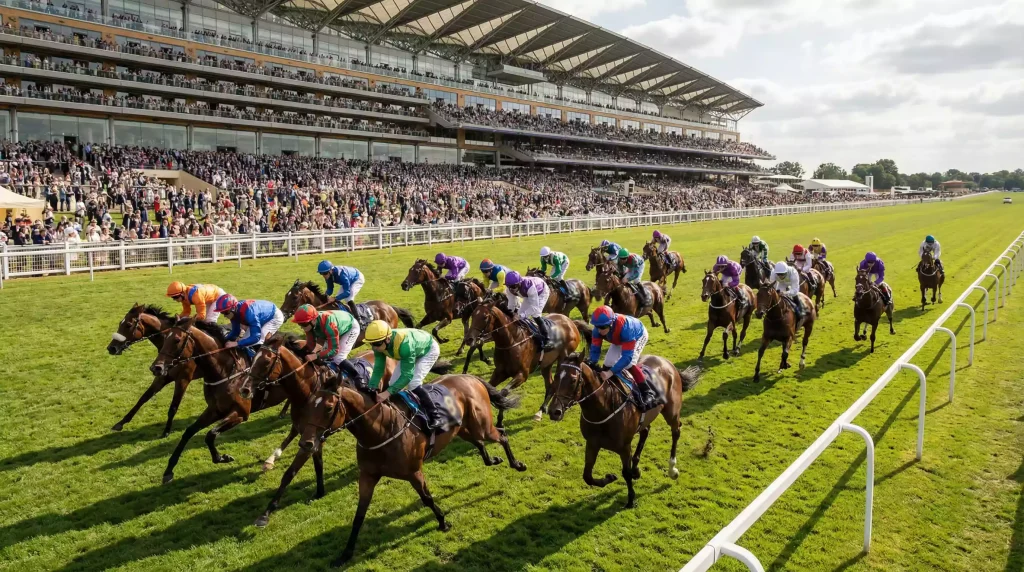
Thursday’s Big-Field Handicap
The Britannia Handicap occupies a special place in the Royal Ascot programme. This heritage handicap for three-year-olds over a mile draws the best young handicappers in training, creating a competitive cavalry charge that rewards both quality and positioning. Britannia handicap tips require understanding patterns that repeat year after year—patterns the market sometimes undervalues while focusing on traditional form analysis.
Three-year-old only races at Royal Ascot produce level stakes profit of +£17.98 at a 35.21% strike rate for favourites. The Britannia contributes to this positive trend. Young horses still developing, still improving, still capable of outperforming their official ratings—these characteristics make three-year-old handicaps fertile ground for value seekers. The handicapper cannot perfectly anticipate future improvement, and bettors who identify horses on the upgrade gain edge.
Thursday at Royal Ascot draws substantial crowds—65,718 attended in 2025—and the Britannia attracts significant betting interest from punters seeking big-field value. The race typically features twenty-five to thirty runners, creating extended place terms and each-way opportunities at attractive prices. Understanding the draw bias, the weight trends, and the form profiles that succeed transforms a seemingly random big-field handicap into a solvable puzzle.
Stalls 15+ Dominance: Draw Data
At The Races analysis reveals a striking pattern: six of the last seven Britannia winners started from stalls 15 or higher. This concentration far exceeds random distribution and demands attention from serious bettors. In a race with thirty stalls, roughly half the field starts below fifteen and half above. If position had no effect, we would expect winners distributed proportionally. Instead, high draws dominate conclusively.
The explanation lies in Ascot’s straight-course characteristics. Over a mile, runners from high stalls can angle toward the stands’ rail—typically the fastest ground—without surrendering significant position. They establish themselves on preferred terrain before the race unfolds in earnest. Runners from low stalls must either stay on potentially slower ground or cross the field, expending energy better saved for the finishing effort.
Ground conditions amplify this bias materially. When soft patches develop on the far side, the stands’ rail becomes more valuable. High-drawn horses access it naturally; low-drawn horses face obstacles. Before the Britannia, check going reports for any suggestion of uneven ground. If softer conditions prevail, weight high draws even more heavily in your analysis.
The statistical pattern does not mean every low-drawn horse loses—exceptional ability can overcome positional disadvantage. A horse from stall five with significantly superior form might still win if their class exceeds the field. However, when two horses appear equally matched on form, draw becomes the tiebreaker. In large-field handicaps where margins are thin, such tiebreakers often determine results.
Three-Year-Old Handicap Form
The ideal Britannia candidate is a horse on an upward trajectory whose rating underestimates current ability. Classic three-year-old improver profiles include: horses returning from a break who showed strong form before it, horses stepping up from six or seven furlongs who have hinted at stamina for a mile, and horses from powerful yards making seasonal reappearances with apparent fitness advantages.
Lightly raced horses offer particular appeal. A three-year-old with only four or five career starts has less exposed form than a rival with fifteen runs. The handicapper has assigned a rating based on limited evidence, potentially underestimating true ability. When a lightly raced horse from a top yard enters the Britannia, they often represent concealed quality the market has yet to fully recognise.
Recent form matters more than distant form. A horse who shaped well when fourth two weeks ago, denied a clear run, may outperform one who won impressively three months ago but has disappointed since. The Britannia field is large enough that horses arrive in varying states of readiness. Prioritise those whose most recent runs suggest they are at or near peak.
Trial race form offers guidance. Some trainers use races specifically as Britannia preparation, perhaps accepting defeat while ensuring fitness. When a horse has contested an obvious Britannia trial—run at Ascot in the weeks prior, or over a mile at a similar track—the connections have signalled intent. That preparation typically translates to better performance on the day.
Weight and Rating Patterns
The Britannia’s weight range typically spans from around ten stone for topweights to nine stone for the lowest. This twenty-pound spread compresses genuine ability differences. A horse rated 95 concedes weight to a horse rated 75, but the pound-per-point relationship imperfectly captures actual ability gaps. At the margins, well-handicapped horses rated in the mid-80s often outperform expectations.
Topweights rarely win. The burden of carrying the heaviest impost against large fields of competitive rivals proves too great in most renewals. Unless a topweight possesses class clearly superior to the field—perhaps a Group-placed horse dropping into handicap company—avoiding them makes statistical sense. The mathematical reality is that ten stone over a mile against twenty-nine opponents is a stiff task.
The mid-range produces most winners. Horses carrying nine stone four to nine stone ten combine sufficient quality with manageable weight. They face competitors close in ability but benefit from slight weight advantages against those above and class advantages against those below. When narrowing a large field, focus on this weight band.
Trainers of previous Britannia winners sometimes target the race year after year with similar profiles. Check whether declared runners come from yards with Britannia history. Some trainers understand the race’s specific demands and prepare horses accordingly. Their runners arrive fit, well-drawn when possible, and tactically suited to the challenge.
Britannia Selection Approach
Begin with the draw filter. Remove horses from stalls one through ten unless their class clearly exceeds the field by a substantial margin. The stalls 15+ pattern is too strong to ignore. Focus remaining analysis on runners drawn favourably, reducing the field to a manageable shortlist immediately. This single filter eliminates roughly a third of the field from serious contention.
Within that shortlist, assess form profiles carefully. Identify lightly raced improvers, horses returning from breaks with strong prior form, and runners from yards with Britannia pedigree. Eliminate exposed handicappers who have run consistently at this level without suggestion of further improvement. Look for horses whose trajectory points upward.
Check weights within your filtered group. Does any horse carry significantly less than rivals of similar ability? Does any topweight possess sufficient class to overcome their burden? Weight analysis refines rankings established by draw and form assessment, providing another layer of discrimination.
Multiple selections suit the Britannia’s complexity perfectly. Three horses at prices between 12/1 and 25/1, all drawn fifteen or higher, all showing progressive profiles, all carrying moderate weight—this approach captures the race’s uncertainty while applying disciplined filters. Each-way betting extends coverage further; hitting the frame with two of three selections often produces profitable afternoons. The Britannia rewards breadth of coverage matched with rigorous filtering, not concentrated conviction on a single horse in such a competitive field.
Britannia Handicap Tips — More on this topic at ascot races betting.
See also Buckingham Palace Stakes Betting.
